Tuesday, January 31, 2017

Decide with the Clarity of Emotional Intelligence

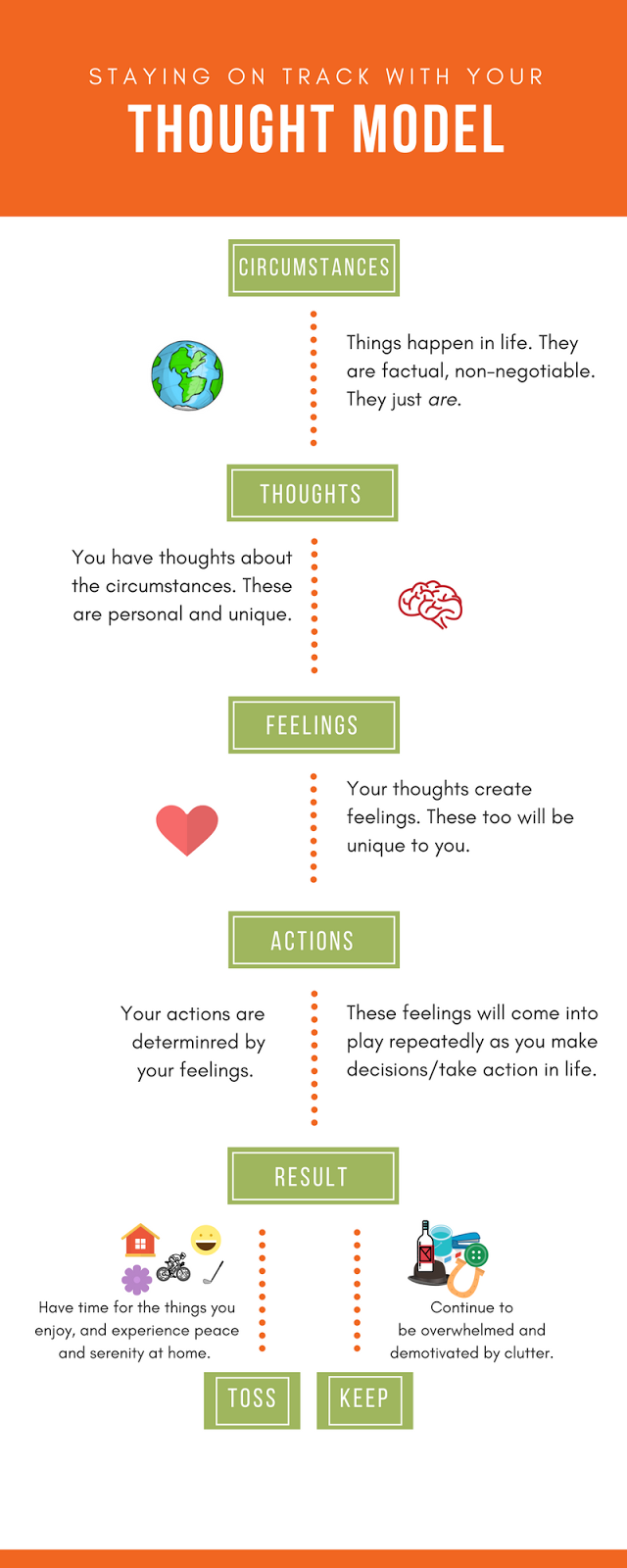
The year 2017 is well underway. There was barely a chance to reconcile with the start of a new year; and we are almost into its second month. Always looking for the best way to help and inspire you in your organizing journey, I was very pleased a couple weeks ago to be introduced to the Thought Model.  Researching online, I discovered this model is integral in the coaching world; the University of California is even touting it as an important tool in managing employees. But I heard it described by a midlife coach, who was using it to illustrate our relationship with our stuff. My wheels started spinning and I couldn’t wait to share with you.


Here we have it, (with my organizing spin): Every one of us faces certain circumstances all day. These are things we cannot change. Maybe your circumstance is a closet full of memorabilia form high school.

Perhaps when you look through that closet full of your past you think things like, I scored the winning touchdown with this football or, I hated that class! or, This is the test that proved I was capable.

Now the feelings are stirring within. What are they? Do you still feel the pride and elation you did that day on the football field? Or do you just smile wistfully and remember what a great day that was?  Are you angry thinking back on that class? Do you sigh with disbelief when you recall how stressed you were preparing for that test? Or are you satisfied thinking of the path your life took, because you were able to pursue a higher education than anticipated?


How do your feelings cause you to act? Do you go out and buy a display case for that football, then put it in your rec room? Or are you happy to put it in a big black garbage bag and say goodbye? Do you want to recycle the text book and free yourself from the negative thoughts of that class? Or do you want that book taking up space in your current life? What about that test? Do you still need it to identify who you are today? Or is it enough to be grateful, remembering that you had a breakthrough that helped shape the person you are today?

And finally, what is the result of your actions? Are you able to eliminate some of the clutter of your past and make room for your priorities today? Or will you let stuff consume your physical space, still not adding value and still not being respected? When we let go of things that no longer add value, we are able to spend our time doing what we enjoy. As well, we feel a sense of pride and relief in our  ability to move forward. When we continue to close a door on the physical items of the past, we have decisions that remain to be made. They wait for us. They overwhelm us and clutter our minds. As you weigh the pros and cons of decluttering your space and your mind, remember that the items themselves are neutral. You are the one who attaches meaning to the items, because of your thoughts and feelings. And you are the one who will reap the benefits of reframing your thoughts and feelings, and allowing yourself to enter into the now of your life.

Wednesday, January 18, 2017

O Christmas Tree! O Christmas Tree!


Another year is quickly coming to an end.  For many, this is a time for reflection, a time of contemplation. What will 2017 bring? We have to wait and see.

For now, I leave you with some of my favourite quotes from this past year.   You may have seen them on my Facebook page or in a blog header.  Or maybe you're seeing these words for the first time.  Regardless, I hope they give you something to ponder as we embark on a new year.

Never overlook the power of simplicity. - Robin S. Sharma

Giving doesn't have to be about excess. - HomePuzzle

It always seems impossible until it's done. - Nelson Mandela

Minimalism. Is about your life. Not your closet.  -  Becoming Minimalist

Discipline is doing what needs to be done, when it needs to be done, when we don't want to do it. - Bobbi DePorter

Clutter is nothing more than postponed decisions. - Barbara Hemphill

However you like to spend this time of year, and whatever your dreams for the future, I hope this holiday is as magical and peaceful as your heart desires.  

Best wishes,
 

Chris

Friday, July 29, 2016

Minimalism: The Next Big Thing

On the coat tails of the Kondo phenomenon, we have minimalism. It’s not new, per se, but awareness of this lifestyle is growing. There’s a lot said about it via social media, and the trend seems to be that it’s the millennials adopting the minimalist lifestyle. They want experiences, not things. They want mobility, not to be tied down -- especially by their things! 

But there is need to dispel some of the myths about this way of life. Minimalism is not a specific formula. You are not forced to own a specific number of items or live in a space of miniscule dimensions. It’s not about living with nothing.  It’s about personal choices. Joshua Becker, one of the more recognizable names in the world of minimalism, writes, “Minimalism is the intentional promotion of the things we most value and the removal of everything that distracts us from it. And while this looks different for each person, it always requires its pursuer to further define his/her passions—and discover intentionality because of it”. Makes sense.


Some turn to minimalism out of despair. This is true of Joshua Becker (quoted above) and also of Ryan Nicodemus and Joshua Fields Millburn – The Minimalists. Nicodemus and Millburn lived what appeared to be pretty amazing lives, but they weren’t happy.  After some soul-searching, the two decided to quit their jobs, leave behind the security of healthy paycheques, and pursue what really made them happy. That lead them to a book tour in 2014 and they have just finished another tour promoting their new movie Minimalism: A Documentary About the Important Things.  I had the opportunity to see the movie when it was released in Toronto, and to see the minimalists themselves. They are two, regular guys. Authentic. Down to earth. They just travel light.

I also recently participated in a discussion on this topic with a group of organizers. The general consensus is that none of us are minimalists – although, according to the Facebook quiz I’ve taken, I am an extreme minimalist J The thing we do have in common is that we live with intentionality; this is at the crux of minimalism. The goal is to think before you buy. Leave behind the forced consumption that plagues western society. Question the value that will be added to your life if you buy just one more of this, or that.  Just because you can own a different coat or pair of shoes for every day of the month, doesn’t mean you have to have them or that they will bring you eternal happiness.

As a minimalist, you live a life that is filled with the experiences, relationships and things that make your life meaningful.  You don’t read from someone else’s script, you identify what truly matters to you and what you need to be happy and fulfilled.

Sunday, May 29, 2016

Grab a Lifeline When Paper Overwhelms


Last week I helped a client to clean out her office, when we came upon a newspaper clipping bearing the same name as this month’s blog post. It was from the Careers section of the Globe and Mail and was dated April 6, 2013. This is noteworthy for a few reasons:
1.     This piece on organizing our paper flow wasn’t in the Life section, or Homes section. It was in a section about being successful in business. So, organization plays a critical role in realizing greater success and peace of mind in our career. Can you imagine the benefits to be realized in your personal life if your living and working spaces at home were organized?

2.     The lovely lady with whom I was working had waited 3 years before grabbing that lifeline (i.e. seeking help). That’s a long time to postpone our personal satisfaction and serenity. Why do we do this to ourselves?  

3.     This topic never gets old or goes away. The Globe covered it three years ago, everyone I work with, entrepreneur or otherwise, complains that paperwork makes them crazy. This is a real challenge for a lot of people.
At the time the article was published, the lawyer who was interviewed said that “having those piles of paper visible and touchable in my office were not helping me be efficient and keeping me calm and ready, but rather increasing my stress levels every time I walked into my office.” Can you relate?
To further prove the point, after getting the piles sorted out, this woman recognized that she spent less time in the office, worked fewer nights and weekends and increased her billings. Have you ever wondered what life would look life for you if the stress created from piles of paperwork were eliminated?
One of the most important tips I can offer, whether in reference to paper or a LEGO collection, is this: Only handle it once (OHIO). Don’t pile paper on your desk, committing to filing it later. File it now. Don’t put an article or research material to the side, promising to make a folder for it later. Make that folder now. The more you pile around you, the more inclined you will be to add to the pile: clutter attracts clutter. You’re the only one who can cut down those paper mountains; and let’s be honest you will feel so much better once you know what’s contained in those papers, than spending time worrying about what’s in there and how you will ever get through the task of dealing with it.

Tuesday, April 26, 2016

What’s the Plan?


In this world of ever-changing technology, fast-paced living and high demands, each of us wears many different hats. The means to learn about almost anything is at our fingertips. We’re expected to produce results in a nanosecond. The pressure is on to be fast, accurate and better than “the next guy”.
I see nothing wrong in striving to do your best. But to do that will usually require time. History tells us this time and again. Benjamin Franklin said “By failing to prepare, you are preparing to fail.” Then good ‘ole Abe Lincoln said “Give me six hours to chop down a tree and I will spend the first four sharpening the axe.” I really like this one. It doesn’t role off the tongue as easily as the words of Ben Franklin, but it’s such a great illustration of how important it is to prepare.
To win the battle, you must put a strategic plan in place. To bake a cake, you must have the necessary ingredients. To appoint your space so that it will be functional and aesthetic, you must take the time to both form a vision of that ideal space, and make sure you have what you need to realize that ideal space. Sometimes we’re too quick to get started on our organizing project, only to realize 45 minutes later that we aren’t equipped to complete the task. Often what’s missing is the space required to bring our vision to fruition. Sometimes we haven’t emptied our workspace of all the things that need to be elsewhere. Regardless of the specifics, the one common truth is that we failed to plan out the steps needed to cross the finish line.


Take stock. If you want to make your kitchen more functional, first make sure that everything you want to keep in your kitchen is there.  This is an important step: you can’t determine how much space you need for something, if you haven’t taken stock of it in the planning stages.

Remove. If you’ve got things in your kitchen that aren’t part of your big picture, take them out.  Put them where they belong, or designate a new home. You can’t successfully set up the space if it’s filled with things that don’t belong there.
Re-jig. Re-jig your thinking so that you recognize these first two steps as being necessary to your success, and not merely delays or a waste of time.

Accept. The reality is, all the pieces may not fall into place the first time around. You might test drive your dream space and discover that it’s not quite the haven you envisioned. That’s OK. It’s perfectly normal to make a few modifications before you can be truly satisfied with your accomplishment. 
Remember.  In the words of Hillary Rodham Clinton, “Fail to plan, plan to fail.” And we don’t want that, do we?

Monday, February 22, 2016

It Didn’t Really Spark Joy


Have you read the #1 New York Times best seller, The Life-Changing Magic of Tidying Up? This little gem by Marie Kondo arrived on the organizing scene about two years ago. The organizing community was abuzz with chatter of the new and somewhat drastic measures proposed by the Japanese organizing guru.
At the start of this year, three different clients asked me about this book in the space of four days. Since I’d had the book on my shelf since last September, I finally cracked it open to see what the hubbub was about. I struggled through the first few chapters. My gut reaction was that many of Kondo’s philosophies were identical to what we see in the North American organizing model. True, her language was different; and reading the message in black and white, it seemed a bit more forceful. My interpretation of the tone made it all very off-putting; in my training there is great emphasis put on the importance of empathizing with the client and recognizing what has happened to bring the client to a point of needing help with their clutter. It’s a touchy-feely approach.
But I did smile while reading the first few pages.  My understanding of the KonMari method was that clients were told to empty out a space completely and only bring back what they wanted in the space.  I had visions of dumpsters being filled and people’s hidden treasures being lost forever.  Not so. When Kondo suggests that people shouldn’t waste time changing habits and doing a little bit of organizing at a time, she is not suggesting that the truck back up and prepare for hauling away a huge load.  What she is suggesting is that you make a concentrated effort and focus on your tidying, (as she calls it), for a period of about six months. Six months. That’s a decent amount of time and I feel it is within the realm of completely achievable and acceptable.  As Kondo explains, six months over the course of a lifetime is not a lot of time – especially when you consider how much you stand to gain from the exercise of tidying up.
There were also two things that I found very impactful. The first, Kondo asks clients if the possessions they are contemplating spark joy. My firth thought was, “What a lot of hooey. This is exactly like me asking a client how they feel about their stuff: Is it useful? Do you still love it? Is it easily replaceable?” But upon further reflection, I had to admit I was wrong. And it wasn’t until I looked at my own clothes that it hit me. That simple turn of phrase has made a huge difference in how I look at my own things. The second impactful idea I took from this book is that we keep a lot of our stuff, just because.  Ridiculous, right? But so true.
Looking at my own stuff with this new perspective, I’ve discovered that I too have things in my life that don’t spark joy and are taking up space just because – and I’m somewhat of a minimalist!!  In the last day, I’ve emptied out 50% of what was in by bathroom cupboards and eliminated a couple pairs of pants that I really hate. And I’m just getting started!!
In conclusion, I didn’t love this book. I don’t agree with everything the author says. But it has resonated with many readers, as Kondo has a three-month waiting list of people who want to get organized using her method. And it did motivate me. In the end, that’s really what it’s about, isn’t it?

Thursday, December 17, 2015

Now, Repeat After Me

December is such a busy month.  Mall parking lots are crazy and the lines inside the stores are lengthy.  Regardless, I love the hustle and bustle that surrounds Christmas.  But before you know it, a new year will be upon us and many will be contemplating their New Year’s Resolution.
A few days ago I was reading an editorial piece by Ashely Gartland entitled Bye-Bye Bad Habits. I was struck by the similarity between her message, my message to many, and the fact that many a message bears repeating. It won’t sink in until just the right moment, and that moment is different for everyone. Breaking bad habits is the same as changing bad habits and that’s what any kind of long term, sustainable change is about.
I’ll recall here the subheading used in Ashley’s article, and compare them to what I often hear myself saying to clients:  
Ashley’s Words
Chris’s Words
Acknowledge your habit
What isn’t working for you?
Look to the future
Let’s set a goal for this space.
Change your environment
If this space holds too many distractions for you, let’s take a boxful of items into a more inviting room and sort through them there.
Substitute a better behaviour
Don’t do everything at once. Pick one thing you will do differently, and do it every time. For example, don’t leave your dishes in the sink, put them in the dishwasher, or wash after each meal.
Hold yourself accountable
Ask someone to be nearby, to keep you on task and help you to stay motivated.
Count on failure
It’s normal for people to backslide when they are working towards long term goals. Think of that nasty, four-letter word, diet. A little setback doesn’t negate all that you’ve accomplished. Keep your eye on the prize.

So, if you’ve struggled to make positive changes, and are left feeling defeated, don’t give up. You can still create the space, person, home – whatever you want – when you hear the message that resonates with you.  
Until that time, shut out all the noise and enjoy this magical time of year. Merry Christmas!!!